- raising
kids is a discipline in itself
In my
latest post about raising children, I was talking about the strange notion some
people have that violence is not only a way to raise kids, but that it is needed
to maintain discipline and respect. I was (I hope) very clear on this point:
spanking is violence! Violence is a no-go!
Today I
want to present an alternative to spanking. Or rather, I want to present an idea of what
disciplining your kids really means. Remember, spanking is a no-go AND
- very important! - IT DOESN´WORK! All you will achieve by spanking your kids
is alienating them and making it impossible for you to help them in their adult
life.
If you spank your kids, you won´t be able to share your wisdom and experience with them, neither when they are kids, nor when they are all grown up; because the day they leave your house to
go live for themselves is the day your influence is declared null and void!
So, what to
do, if violence doesn´t work? Do we not need some kind of power as parents?
Some kind of leverage to get our kids to do right?
Force is a tool for change, not learning
Well,
yes... - and no! - The basic mistake is this: the use of power is not - and I
repeat: NOT IN ANY WAY - a tool for teaching your children anything. And I
really mean *anything* - the use of power is a tool to get their attention,
nothing more, nothing less. That makes power the last tool to grab from
your parenting tool box, not the first or even the 10th.
I also need to emphasize that mentioning 'the use of force,' I´m
not just talking about spanking. I´m talking about every and all uses of force,
that is: any kind of action, where you as a parent use your power to make your
kid do (or not do) what he/she doesn´t want to (or want to) do!!!
I just stated that the use of force doesn´t teach your children anything in itself. The reason is quite simple. No person in this world can truly learn anything important, if it is not learnt by heart. That is: true learning is not something going on in your brain. It´s not knowledge alone, it has to be combined with what you might call wisdom. It´s not a coincidence we use the term 'learning by heart' because really learning is about taking the knowledge in and implementing it in your life - willingly!
Let me give
you an example from the adult world:
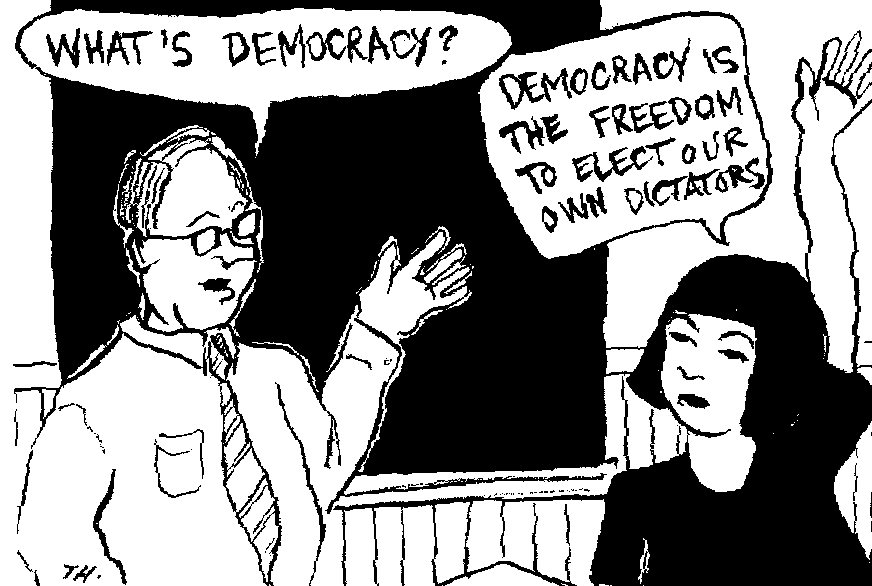
When ‘the
coalition of the willing’ invaded Iraq, some of the most hard core politicians
genuinely thought they could force Iraq into modern day democracy. Did they
succeed? I think not... But! - what really *was* a success was the fact that a
democracy was born from the ruins.
Not a democracy like we know it in the
western world, but this is where we should remember that our democracies
weren´t exactly free democracies in their childhood either. For instance, it
wasn´t till the 20th century women were eligible for governing organs and
neither did they have the right to vote in most western democracies before 1930
(in fact, the final canton in Switzerland to give women the right to vote didn´t
till 1984!)
Iraq began its journey toward democracy following
the invasion, but the Iraqi people have to find out the rest for themselves...
The same
goes for children. You cannot force upon them the complete understanding you
have gained from experience. They need to figure it out for themselves. But
what you *can* do is force them to stop for a moment and think. And when they
stop to think, they just might come to the conclusion that it is better to
start listening to you.
Here there
is something very, very important to understand about the use of force: you
have to let go of that tool as soon as you see them stop and think. If you don´t, you shift the focus for learning from 'learning best way' to 'learning how to make mum and dad happy.'
I probably don´t have to say this, but I´ll do anyway: This is just as useful in the discipline of raising kids as Burgers and fries as the main meal is good for your health.
The use of
force is ONLY to be used as a wakeup call, nothing more. If you continue the
use of force after they start to listen, you will force the child to replace
their own thinking with an escape plan: ‘how can I get mum and dad to like me
again?’ And this is never good.
Instead, as soon as you see the child stopping
to think, let go of the power. Give the kid a chance to make up his/her
mind and figure out that the best course of action right now is to listen.
Fear the right thing
My second
point is about fear. Having a basic understanding that children are human
beings with less experience and equally valuable to any adult, the intuitive
understanding of fear is that if the kid experiences fear, it can never be a good
thing... However, it´s a bit more complicated than that.
All human
being experience fear and in modern society fear is one of the most common barriers
for success. Fear can make us hide when we need to stand tall and fear makes us
bend to other people´s will, when we need to make up our own minds. For those
reasons (and many more) the popular understand is that fear is, per definition,
‘bad’ - but really that´s not the case. Fear is neither bad nor good. It´s how
we react to our fears that determines good or bad.
My
father-in-law was a farmer and the first time I entered the stable I had
somewhat of a chock. The sight of 50+ milking cows´ rear end lined up on each
side of me made me freeze right there on the spot. This was new to me and I was
struck with fear, because I didn´t know how to handle these animals. Fear made
me cautious; a good thing. My response to this fear was to observe, how my
father-in-law handled the cows and little by little, I learned how to handle
them as well.
I feared
the cows and looked to my father-in-law to learn how to handle them and this is
exactly what your children need to do in their lives: they need to understand
that listening to you and observing how you do things can benefit them.
In other
words: if your kids fear you, it´s a bad thing - but if your kids fear not
listening to you, it´s a good thing!
Let´s sum
up this post:
#1 - Force is a tool for change - As a
parent, if you want your children to learn from you, power is to be used with
caution. You cannot force your experience upon them and if you try, they won´t
gain any wisdom. They will only become experts in making mum and dad happy. And
even more importantly (though this is not very clear in the above due to my
wish to economize writing space) if you try to force your experience on them,
their focus will be on weither mum and dad loves me or not as opposed to mum
and dad knowing best.

#2 - Fear the right thing - The use of
power is a tool for getting the attention of your kids, but it´s important to
let go of that tools as soon as you reach that goal - if you don´t, your kids
will fear *you* instead of fearing their surroundings and look to you for help
and wisdom. However, using force in the above mentioned way, you can get their
attention and as they experience over and over again, what happens if they
don´t listen to you, they will learn that one important lesson: listen to mum
and dad, because they have been around for some time and most of the times,
they have a few things to teach me.
For a tool using these principles, see this
Now, it´s your
turn. Do you have experience you want to
share?


 If this is
the case: there is no time or it´s a bad time; then we must understand that
using the time out can be devastating. As a parent, I must win all battles! If
I lose a battle I have to start all over again, because the kid has learned,
that sometimes you budge, even though you said you wouldn’t.
If this is
the case: there is no time or it´s a bad time; then we must understand that
using the time out can be devastating. As a parent, I must win all battles! If
I lose a battle I have to start all over again, because the kid has learned,
that sometimes you budge, even though you said you wouldn’t.