Showing posts with label children. Show all posts

Monday, June 24, 2013

How to deal with your ADHD child #6: The power of expectations

The power of expectations
One of the most basic characteristics of mankind is that we are social creatures. We gather in groups to form protective communities and societies. For these communities to work the way they are intended, we need guidelines, without which our societies would simply break down.

These guidelines are more than just laws, but also norms and culture. But having such rules is not enough. We need ways in which these guidelines can be enforced.

Breaking a law, you are punished in forms of imprisonment or financial penalty.
Breaking the norms of our community equally results in punishment, although in a different way. Breaking norms, you are punished when people do not welcome you in their fellowship or your social status in the group goes down the drain due to inappropriate behavior.
Because of this, we have developed a strong urge to live up to other people’s expectations in order to achieve social acceptance. This is a good thing. Without it, we would not get the benefits of being protected by our community.

The bad news
However, there is a downside: our urge to live up to other people’s expectations goes for both positive and negative expectations. If you expect other people to be kind and forthcoming, they will try to live up to it – and if you expect other people to be selfish and cold hearted, they will try to live up to that expectation!

The good news
In every kind of relationship, you can use this knowledge to better the lives of both yourself, your family and your community. When actively working with yourself and trying to change your expectations to be positive rather than negative, you can actually influence other people, because they will try to live up to those positive expectations.

In a nutshell: If you show your ADHD child that you expect them to do well in school, they will work very hard to prove your trust in them is not misplaced. But if your ADHD child gets the notion that you expect them to do poorly at school, they will not believe in themselves and they will not work toward such a goal.

So, basically, it's your call...
-------

Find previous chapters here:
Chapter 1
Chapter 2
Chapter 3
Chapter 4
Chapter 5

If you want to be sure to not miss anything, please subscribe to the newsletter


What did you find helpful in this chapter?
What should I do to improve the above text?
Please feel free to comment:

Thursday, June 20, 2013

How to deal with your ADHD child #5: What's your Resilience Number?

Being a father of two children with ADHD issues I have noticed that their reactions to other people’s demands sometimes seem to be arbitrary. Sometimes they take on a task as if they were normal children with no ADHD issues at all, but the next day that very same task suddenly becomes a mountain high obstacle they feel they can’t overcome. Maybe you have noticed it as well?

Having ADHD even the simplest task can be overwhelming and in the end may discourage that person the point of just giving up.

One day their homework is done in almost no time at all and the next day they can’t even find the energy to open their books and get to work, even if their homework that second day is much easier than it was the day before, when it seemed to be like a walk in the park?

It may seem strange, but there is a quite simple explanation for this apparently arbitrary behavioral pattern.

Each day your child fights the challenges of having ADHD and every single battle requires energy. Of course, this is true for all of us, but for the person with ADHD the energy consumption is much higher than that of normal people. Additionally, their level of stress has a huge impact on how well they do when fighting to achieve the best possible life.

When your ADHD child has a surplus of energy it can perform almost any task as if they had no ADHD issues to fight – but when your child has a worn down battery? Well, basically… Everything is a mess!

When this situation emerges, there is really nothing you can do about it. It is what it is: no juice, no movement! But the good news is that there are ways to prevent or at least postpone those situations.

One of the most powerful tools I’ve ever encountered in my learning experience of being a father of children with ADHD, is the “Resilience Number.”

In order to have some kind of understanding on how much more your child can take, you need to get your child to tell you about it. But having ADHD it is almost impossible to say with words how you feel and what you think you can accomplish.

The Resilience Number takes care of this problem in the simplest way: instead of trying to encourage your child to explain with words, how they feel, you may have more success asking them to give you a number. This number can be on any scale you like: 1-5, 1-10, 1-100 or whatever you think works best.

On that scale, the number 1 means that you are completely exhausted and that there is nothing left in your battery to deal with your ADHD issues at all. The highest number means that you’re ready for the world to come barging in and make any demand and you would be able to take on anything as if you had no ADHD issues.

How to use the Resilience Number
Let’s say the scale is 1-10 and your child comes home from school.

You ask about their Resilience Number and get the answer “7.”

This means that your child is fairly capable of getting their homework done as long as you’re available if they have questions.

If you get the number “4,” you may want to let your child rest for a while, give them some time off without any kind of demands. Then, an hour or two later, your child could be ready to get their homework done.

If the number is between 1 and 3, you might as well accept that their homework will not be coming anyway near to getting done that day.

If your child’s Resilience Number is 9 or 10, you can easily go do the laundry or go shopping while they complete their homework.

The point?
Did you get the point of the Resilience Number?
By using this tool you basically get an idea on how much more your child can take and act accordingly.

If your child has a low resilience, you know it is time to give them some rest in order to "recharge" their batteries.

This way, instead of exhausting your child and get to a point where nothing positive can be accomplished, your child is given the chance to raise their resilience and then, when they are ready, you can begin making demands.
You will find this to provide you and your child with a decrease of those not very fruitful battles AND an increase of situations where challenging your child actually improves their abilities both socially and school wise.

A note on responsibility!
Being the intelligent and wise parent you are, this probably already popped up in your head, but I’m going to say it anyway, just to be clear:

Your child is just as much of an angel as you were when you were young. It’s your responsibility to come up with ways to detect a lie!

Having said that, rest assured that if you explain to them what the Resilience Number is for and that when using it honestly, it will make their lives much easier, they will – in time – learn to not abuse your trust.
-------

Find previous chapters here:
Chapter 1
Chapter 2
Chapter 3
Chapter 4

If you want to be sure to not miss anything, please subscribe to the newsletter


What did you find helpful in this chapter?
What should I do to improve the above text?
Please feel free to comment:

Monday, June 17, 2013

How to deal with your ADHD child #4 Tough Love well practised

I've already posted a few chapters of my coming book, "How to deal with your ADHD child."
You can read them here:

Chapter 1
Chapter 2
Chapter 3

And now for chapter 4:

On this blog I brought a post in April 2012 with the title “How to spank your wife” This post is by far the most read on my blog and the reason is obviously that provoking title. The aim of it was to bring some perspective on a term, we’ve heard again and again as parents: “Tough Love.”

As is the case with most terms and phrases when they become popular, “Tough Love” has, in my opinion, been subject to quite a bit of misunderstanding and misinterpretation.

Basically, “Tough Love” is the notion that for anyone to truly show their love for others, sometimes it is necessary to act in a way that could seem heartless, but are done anyway, because in the end, these actions inflict less pain on the person you love than if you had acted differently.

The challenge is to understand what tough love should be if it is to be a successful tool in bringing up our children and specifically when it comes to children with ADHD.

Tough Love is a strong tool, but in many cases this term has been used as an excuse to continue feeding patterns, which are really very unhealthy for all parties involved. If Tough Love is used based on a wrong understanding of what it really is, it will have a bad influence on your child and you risk ruining their self esteem.

All this applies for every child, but having children with ADHD, it becomes even more important. Children with ADHD usually have lower self esteem than other children, because their lack of understanding social norms makes them act in ways that are sometimes inappropriate. The natural outcome is that for a child with ADHD, verbal abuse, not only from other children, but unfortunately also from adults in their lives, is the order of their world. They get emotionally beaten every day and of course their self esteem is worn down.

As a parent or an adult working with children with ADHD, you have a special responsibility to try building up that self esteem and the above mentioned issues do not only count in regards to physical abuse, but stretches out to verbal and emotional abuse as well.
-------
Read Chapter 5

If you want to be sure to not miss anything, please subscribe to the newsletter


What did you find helpful in this chapter?
What should I do to improve the above text?
Please feel free to comment:

Thursday, June 13, 2013

How to deal with your ADHD child - #3

I've already shared two chapters of my work in progress, the parenting guide "How to deal with your ADHD child."

The first chapter is mostly an introduction followed by a brief explanation on how ADHD affects life, both for the person with this disability and for the entire family.

The second chapter is basically a test: are you ready to embark on a journey to become a better parent to your ADHD child with all the pain and life value reconsiderations this may hold?

In the third chapter I will present you with three key words. These key words are meant to be easy to remember and practically adaptable to your every day life as a parent to an ADHD child.

Ready?
Here we go:

-------
Basic key words
In this chapter I will present you with some basic key words. The aim of these key words is to provide you with something easy to remember that you can always fall back on, when a situation gets tense. To get the most out of this book, I encourage you to memorize these key words and get them imprinted in your heart for quick access in those difficult situations, where things get really troublesome.

Keyword #1: Firm Patience
Remember that a person with ADHD is not deliberately trying to be a nuisance. They have issues making it hard for them to interact with other people in the most common way. This is a part of their behavioral challenge. This means that for you to be the best parent possible you need to be patient.

But there is more…

Being patient, however important it is - and it really is! - it does not sufficiently help your child, if it stands alone. There's another element that enhances the power of patience: Being firm!
You need to be firm in the way you discipline your children and in the way you pass on your values and share your experiences.

No child has the experience needed to know right from wrong and for a child to learn, the parents must be firm. This is even more important when raising an ADHD child, because having ADHD makes it even more difficult to sort out issues based on their importance. As a parent to an ADHD child you have to be the filter he/she doesn’t have. Therefore, your firm character is necessary to give your child the best foundation possible to take their first few steps toward independency.

So, these two put together: Being firm and being patient, become Firm Patience, a very powerful tool in any kind of work raising a child. The patience establish positive relations between the two of you and the firmness raises your child to the best possible base for a good life.

Lose the chatter
When communicating with others we tend to use more words than we actually need. There are many reasons why. One reason is that using words is a sort of tool to get our thoughts sorted, that is: we think when we talk. Another reason could be our wish to be polite in the manner of which we address each other.

In most cases, this is not a bad thing. It usually improves our communication and helps us building relations with each other. But when communicating with someone with ADHD the excessive use of words has the very opposite effect. One of the basic challenges when you have ADHD is the lack of concentration and the difficulty of sorting which input is important and which is less important.

And when a sentence has more words than needed to pass on the intended message, the person with ADHD needs to use way too much mental energy in trying to figure out what that message is.

A person with ADHD has a much better chance of understanding what you’re trying to say, if you lose the chatter – that is: if you get rid of words not needed to pass on your message.

Choose your Battles
Every parent knows this: choosing your battles greatly improves the chance of success. But being parents to children with ADHD, this advice is crucial!

Having a child with ADHD you face all the issues of having a ‘normal’ child multiplied by 100. Facing each possible battle you would do yourself – and your child – a great favor, if you stop to think for a second and ask yourself two questions:

#1: Is this battle important to take on?
#2: Is this a battle that can wait?

The first question seems rather simple, but as you probably know it really is quite complicated. Most of the time, we don’t think too deeply about our own behavior. Our actions and decisions are based more on patterns we’ve built throughout our lives rather than carefully considering our options in each situation. And of course it has to be this way. If we took the time to think through every possible outcome of every single choice in our lives, nothing would ever be done.

But if we are to improve the outcome of our efforts, in parenting as well as any other part of life, occasionally we need to stop for a moment to ask ourselves what the best course of action is – and more importantly: why?

The second question is about prioritizing our efforts. Even if the battle in front of us is an important one, it’s not always beneficial to fight it right now. From time to time, it’s better to let it go for the time being and wait for a better time to take it on.

When asking yourself if the battle can wait, you should include another question: if I take on this battle now, what are the chances that my child and I can win the battle together?

Always remember what I pointed out earlier: you are in this together and no battle is won before you both gain from its outcome. If you win a battle, but the outcome does not better the situation for your child, then you really have gained nothing and the battle has been lost for the both of you.

-------
If you want to be sure to not miss anything, please subscribe to the newsletter


And now it's question time
If you have been following the latest posts on this subject and if I have provided you with anything useful, you might have some questions you would like to ask?

It could be anything: questions about the text itself, questions about ADHD in general or questions about real situations in your every day life dealing with a child with ADHD.

I will try to answer any kind of question to the best of my ability and remember this:

The only stupid questions are those never asked when given the chance, because not asking is the only sure way to not get an answer - and that is kind of stupid isn't it?

Additionally, I'd like to focus your attention to my new FaceBook Page, where you can keep yourself updated, ask questions, share your story, give and get advice etc.

How can you use what you´ve read till now?
Is there something you would like me to elaborate?
Feel free to tell about your situation and ask me for advice:

Wednesday, June 12, 2013

How to deal with your ADHD child - #2

In my last post I told you that I'm writing a book on how to deal with your ADHD child. I posted the first draft of the first chapter and promised to keep posting chapters encouraging you to comment on the content. Today I present you with the second chapter:

-------
Chapter 2: First you decide if you want to go on this journey

In this book I will present you with some of the situations you probably know all too well. These are situations you and your child find yourselves in on a regular basis and give you both a lot of grief and frustrations.

Please note the way I phrased this: these situations are the source of much grief and frustration, but not only to you; to your child as well. You are in this together!

Presenting these situations would be fruitless, if I did only that. So, of course, to give you some benefit from reading this book, I will also provide you with some tips and tricks that have proven their worth in my own home or in homes of other families, where ADHD plays an important part.

But before presenting these troublesome situations, I’d like to focus your attention to your own basic standings and understandings. For you to succeed as a parent to a child with ADHD, you need to look inside yourself and ask yourself some questions that may be quite painful to your self understanding. The reason for this is that your basic understanding of what ADHD is and what kind of personal view you have on this disability greatly influences your everyday approach to your child. In other words: these are questions about your basic life values.

So, if you’re ready, strap on and join me on this expedition to your inner self:

Question #1: Is my child abnormal?

Interesting question, isn’t it? Reading this book you probably have a child, grand child or some other family member diagnosed with ADHD, but what does it mean? When you look at the child, what is the first thought that comes to mind? Is he/she a crazy person ready for the local nuthouse? Is he/she beyond reach? Will he/she never get a life even remotely close to something resembling a normal life? Or do you believe in the potentials of him/her?

Let me say this a bit bluntly: if you sincerely believe there is noting you or anyone else can do for this child and that he/she will never live a life worth living, there’s really no reason for you to read the rest of this book. I can’t help you…

However, if these negative thoughts have entered your mind and you believe they are no more than a frustrated person’s reaction to a difficult situation, it’s a whole different story. Those thoughts are quite normal, but they can be dismissed, if you want them be dismissed. So, do you want to change your own thinking? Then read on!

If your answer to the above question is something like: yes, my child is abnormal, but who is normal anyway? He/she deserves all the best things in life and I’m prepared to fight for it! If that´s your answer (or if your answer was just plain: no, my child isn’t abnormal, just a bit to the side, but we’ll manage together) – well, then we’re on the same page…

Question #2: Have I ever wondered if it was better that my child hadn’t been born?

If the first question was painful, this one should be really painful! No (normal) parent would ever think that, would they? Hmm… honestly? I think it’s quite normal to think that… Sometimes we parents think that kind of thoughts, but you know what? We don’t think like that because we are bad parents; those thoughts enter our minds because of our own insecurity. Again and again we doubt ourselves as parents: am I a good enough parent? Do I give my kids all they need? Am I even fit to be a parent yelling at them like I just did?

Thinking like that isn’t good, but it doesn’t come from being a bad parent. It comes from our wish to be good parents and every time we think, we are not doing a good enough job as parents, we simply let our deepest desire to be good parents come to the surface. We occasionally think like this, because deep down in our soul, we just want to do better! So, if that thought ever entered your mind – and, if it makes you feel bad – chances are you are a good parent always wanting to improve yourself and do better as a parent!

Question #3: Am I ready to fight both internal and external battles?

I think most parents, at least those who bought this book, would answer this question with a big “YES!” But you need to think about it in more detail. The journey you are about to embark on is not to be taken lightly. You will face battles you hadn’t even imagined before. Most external battles you know pretty much all about: battles with other parents, who do not grasp the situation and who believe all the issues with your child is merely a matter of bad parenting or a bad willed child; battles with teachers and authorities; and of course battles with the child’s grandparents and other family members, who don’t get how far having an ADHD child stretches your patience and your energy.

The internal battles, however, are a very different matter. Most of us seldom share our most inner thoughts with others and because of this, we rarely know the truth: that parents with an ADHD child has to fight internal battles, where we have to change some of our fundamental values to better the lives of both the ADHD child and the rest of the family. The journey of a parent having an ADHD child requires swallowing quite a few camels and you may as well embrace this truth sooner than later.

-------
Read chapter #3 here
If you want to be sure to not miss anything, please subscribe to the newsletter


What did you find helpful in this chapter?
What should I do to improve the above text?
Please feel free to comment:

Monday, June 10, 2013

How to deal with your ADHD child

I've thought about it for quite some time, but never really got around to it: I want to write a book to provide parents who have children with ADHD with some hands on tips and tricks on how to deal with having an ADHD child.

But I want to make sure my book is worth the read. I want it to contain information you need as a parent to an ADHD child and I want it to be practical, easy to apply in your every day life.

That's why I decided to make my first drafts of the book open to you in the hope that you will comment and help me develop the book to be "just the thing."

So, with no further ado, here comes the first chapter of:


"How to deal with your ADHD child" - a hands on guide to improve the life of the whole family by Per Holbo, father of two children with special needs.

-----
Introduction
According to “The 2000 US Census” about 19 percent of the US population have disabilities. In the old days, a disability or handicap was defined mostly as something physical, i.e. the loss of movement or control of your limbs. But in the recent years, this has changed. More and more professionals have come to realize, that there are disabilities not visible to the eyes. One of these is Attention Deficit Hyperactivity Disorder (ADHD.)

Since I am neither a medical doctor nor a psychologist, I will refrain from explaining this condition from a medical point of view. This would be the ‘input’ of ADHD. The aim of this book is instead to explain the ‘outcome’ of ADHD, that is: what are some of the consequences in having ADHD as a part of your life and how can you deal with them?

The fundamental base of my expertise in this matter is two-fold: I was diagnosed with ADHD at the age of 35 – and two of my four children have similar disabilities (a boy aged 14 diagnosed with Other Childhood Disintegrative Disorder and a girl aged 12 diagnosed with ADHD)

The basic challenge of ADHD
Imagine waking up every morning and the first thing you have to do is putting together a jig saw puzzle. The pieces of this puzzle are scattered on floors and tables, not only in your own bedroom, but in every single room of your house, so before you can start putting the pieces together, you need to find them. Then, as you think you’ve managed to find them all and begin putting them together, someone comes into your room adding or removing pieces and you have to start over.

This is one of the ways ADHD can be experienced. A person with ADHD has difficulty figuring out which impressions are important and which are not. To deal with this, they have to put the pieces together. It is important to understand that this is no way to be compared with OCD (Obsessive-Compulsive Disorder.) Having OCD certain actions are performed as a ritual. For a person with ADHD it is merely a need to sort out what is important and what is not – and then sort out what needs to be done first. This is something we all do, but for a person with ADHD it is much more complicated due to the challenge of concentrating on the task at hand and the challenge of being easily disturbed by additional impressions.

This presents the ADHD child with two basic issues:

Behavioral problems such as:
Acting on impulse
Acting inappropriate
Losing focus
Failing to fulfill even the most basic requirements and demands from other people

Development problems such as:
Failing to decode norms
Not learning as fast as other children their age

An example:
John has ADHD. He is 10 years old and has just come home from school. The first thing, he needs to do is his homework. If John didn’t have ADHD, he would simply get his books, pencils and paper and begin. But having ADHD this is a much more likely scenario:

John opens his school bag to get his math book. As he grabs the book, a cat walks by outside the window. He lets go of the book and goes to the window to observe the cat. His patient mother reminds him of his homework and he goes back to getting his math book. He places the book on the kitchen table, but as he goes for his pencils his focus is once again disturbed by a yo-yo lying right beside his pencil case. Instead of grabbing the pencil case, he takes out the yo-yo and starts playing with it. Again his patient mother reminds him of his homework… and so on…

Even the slightest thing can disturb John’s focus to something else than he should be focusing on and it is not a question of bad behavior. He just can’t keep focus on what he is supposed to be doing. The impressions of hearing a bird singing outside the window or observing someone walking close to him catches his attention and he simply forgets everything else around him. He has to focus his attention on these new impressions in order to address them – then, he can get back to what he is supposed to be doing.

The behavioral issue in this case emerges as failing to do the fairly simple task of getting out everything needed for doing his home work and failing to organize that very task.

The developmental issue in this case is obviously that not doing his home work will leave him behind in knowledge compared to his class mates.
-------

If you want to be sure not to miss anything, please subscribe to our newsletter


What did you find helpful in this chapter?
What should I do to improve the above text?
Please feel free to comment:

Thursday, May 17, 2012

Scoundrels put flowers on our doorstep

Today I had an amusing experience with some of the kids in our neighborhood.


A couple of days ago someone left flowers on our doorstep and my wife and I thought it was our children. But today it was revealed that the flowers had been left there by someone else. Someone unexpected. We were in the kitchen getting ready for lunch (today is a holiday in Denmark) and the door bell sounded. Out the window we could see some girls running behind a wooden fence to hide. They were about 13-14 years old and we knew they had to be the ones who rang the door bell.


Now, I could´ve gotten angry and told them never to do such a thing again. To be honest: if I´d been in a bad mood, that might just have been my chosen course of action. But really, what would that have accomplished for anyone?


So, instead I did something they certainly didn´t expect as far as their faces could tell. I swooped the door open and ran out yelling at them: "I´ll get you for this!" and coming round the fence, I saw three surprised teenage girls, when I said in a kind manner: "You didn´t expect this, did you?" At first, they were speechless, which in itself is quite the accomplishment when dealing with giggly teenage girls in my experience. But then one of them looked at me with a smile and said: "Did you like the flowers?" Flowers? I had rushed so fast out the door that I actually hadn´t seen the flowers they´d put on our doorstep and now it was my turn to be surprised. "Oh, you are the ones who are putting flowers on our doorstep. Sorry, I didn´t see them. But hey, if you´re going to be mischievous, this is the way to do it! Thanks for the flowers, you scoundrels!"


I had a big smile on my face and so did the girls. What a great way to start a holiday!


How did you start your holiday?

Tuesday, May 15, 2012

Building blocks of a human being - Definitions

This post is a follow up on my previous posts on how you can raise your children without spanking them and do a much better job at it!


In a way, I am skipping a step, but this is necessary for me to make a very important point regarding some of the terms I´ll be using in coming posts. These terms are:


#1: Self Awareness
#2: Self Esteem
#3: Self Confidence


These three are the building blocks of any human being and have tremendous influence on your behavior as a person. But quite often we mix them together.


Quite often I hear people speak of Self Esteem and Self Confidence as if they were two words explaining the same thing. This is a mistake. These two are to some extent intertwined, but if you want your children to grow up as strong and kind adults, you need to get the difference between them.


I´ll be going deeper into these three terms in some of the coming posts, but for now I´ll define them like this:


#1 Self Awareness
Being self aware is an ability that separates human beings from animals. Self Awareness is a necessity for us to know who we are. It´s what makes us understand how we are like other people and how we are different from other people. Without Self Awareness we will separate us from ourselves and never be able to be anything else than biological machines. Our existence depends on our self awareness, because without it we are like robots not choosing anything, but just following the crowd.


#2 Self Esteem
Self Esteem is often confused for Self Confidence, but Self Esteem is much more important than that. Self Esteem is basically built on our Self Awareness our surroundings being the builders. Your mum and dad are the primary Self Esteem builders and how they act can either build up your Self Esteem or tare it down. Self Esteem is high when you understand that you have a basic right to be who you are. Self Esteem is built when others acknowledge and confirm your emotions. I´ll be going much deeper into this in another post, because it very important to understand the difference between acknowledging your emotions on one hand and accepting your actions on the other. These two: acknowledgement and accept are NOT the same!


#3: Self Confidence is a picture of the moment
Self Confidence is closely connected to your most recent past. Your successes and failures not too long ago has a major impact on your Self Confidence. This means that while a strong feeling of Self Confidence is important when you need to perform, such as priming an exam or hooking a major client for your company, Self Confidence is very fragile and the smallest failure can brake it down easily if there is nothing else to hold you up. The reason for this is that Self Confidence has to do with your skills. What you have recently achieved or failed at determines your Self Confidence.


Your turn. Share, ask, comment. Do you feel self confident?

Tuesday, May 8, 2012

A family project

Remember when I talked about the trampoline in our garden a few days ago? I was giving you some insight in some of the play things we have in our garden and I told you that they are being used by both our own kids and the kids in the neighborhood...


Now, it doesn´t look like much today. It´s been well used and of course it wears. Still, this trampoline is one of the most important play things at our place. Not only because it´s the one thing the kids use most and not only because it´s one of the favorites among the neighborhood kids. Not even the fact that it gives our children the opportunity to train their body and their balance is what makes this toy have a special places in our hearts.


No, this toy is special to us because we´ve built something together as a family. Not the trampoline in itself, it came in a package and all we needed to do was to assemble the parts and bits. But for safety reason´s we dug it down as you can see in the picture. We did this as a family. Everyone took part in it and did their part. Even our youngest, who was at the time only three years old, did his job digging it down.


This is how we did it:


My wife and I took shifts with the shovel in the hole and put the dirt in buckets, which were then placed on the ground. Two or three children at a time would then bring the buckets to our trailer cart where my wife or I would empty the buckets and the children brought the bucket back to the hole to be refilled.


Most of the time our youngest boy, knowing he wasn´t strong enough but stubborn enough to not wanting to admit it, would be in the hole with my wife or myself picking up stones in a smaller bucket and bring them to the trailer.


The project was finished after three days and since we all did our part in it, that trampoline has a special place in our hearts.

Thursday, May 3, 2012

Neighbourhood kids playing in our garden!


- a sure way of knowing summer is here...

My wife and I live with our children in a house with a garden about the size of half a soccer field. In our garden, there is a sand box, a trampoline, some swings and a bar for balancing on. We built them all ourselves, except for the trampoline, of course. The sand box is made by putting 10 boards together, 2 on top of each other, so that it forms a pentagon (not the US military thingy, but with the same shape...)

We´ve just removed it, because the kids think they have grown too old for it, so right now it´s been taken apart and is lying in bits and pieces by one of our apple trees.

The trampoline is still in use. We´ve had it for 5 years now and digging it down was a family project then, but I´ll be posting on that some other time.

The swings were a gift from my wife´s brothers and they got it up while we were having a party in the garden 6 years ago.

And then there´s the balancing bar which is something I put up a few years ago for my daughter, who was having some trouble keeping her balance at the time.

Why am I telling you what´s in our garden? Well, this post isn´t really about these things, but more about something that is very important to us as a family. We want to be a hospitable family. We want everyone to know that they are welcome in our house and in our garden. 

One of the first week after we moved in some of the neighbourhood kids were standing by the boarded fence on the one side of our property with their faces firmly against the fence trying to look through the cracks between the boards and when we saw them, we invited them in.

Ever since then, one thing tells us summer is on for sure: all the kids from the neighbour start visiting us in our garden. Sometimes even when we´re not at home ourselves! (That´s okay, too, if it´s okay with their parents...)

And you know what? It´s summer time in our garden!

Your turn! - Share your stories or ask questions...

Wednesday, April 18, 2012

Want to smack your kids?


When I published the blog post about spanking there was a comment on about how paradigms and views are handed down from one generation to another. In this comment, a guy had had a debate with someone in a coffee shop about spanking. A man participating in the debate was pro spanking and became quite agitated through the discussion. After some time he was so outraged that he got to his feet and almost shouting announced that he had been spanked as a child and that it ‘hasn´t done me any harm!’

The reply to the angry fellow´s claim was just one sentence that stuck in my mind after reading it, because it really sums it up in a clear cut way. It went like this: ‘yeah, it did. It made you want to beat your kids...’

This is very much true! Your parents have put a mark on you, that will always follow you through life and this mark will influence what you do. This is not to say that if you were spanked as a kid, it´s inevitable that you spank yours. Not at all! The cycle can be broken, if you want to break it. I know, because I´ve been spanked as a kid myself and for many years I said just about the same thing as the before mentioned angry man.

What I learned by being spanked was that if there is something you want and you can´t get it by explaining why you need it and make a good argument for obtaining it, there´s always the last resort of dealing out some punches.

Not a very flattering thought, I know. Fortunately, I´ve never beat up my children and I feel confident, it´ll never happen. But I must admit to myself, that the urge to hit them, when they really misbehave, is there! I do feel that urge and the worst thing I can do is to deny it. Denying it would do me no good at all. Denying that this urge exist in me would only build it up inside of me and who knows, what would happen then?

So, however deflating this is to the positive image you may have of me, I admit it freely: I sometimes feel the urge to fling out a hand on my children! And you know what? If you have that urge yourself, try admitting it. It is one of the most relieving feelings to admit all the bad things going on inside of you. And even more importantly, admitting it to yourself is the first step to fighting that urge.

And one more thing I want you to understand is that there is absolutely nothing wrong with you, if you have this urge! It´s perfectly natural. In fact, all the people on this planet have thoughts about hurting someone. 

It´s been said, that most people have even thought of killing someone, though there is no way of knowing if this is true or not. What *is* true, however, is that the one thing separating perpetrators from other people is not their urges and thoughts. It´s how they respond to them. Keep this in mind every time you might feel guilty having the urge to hit someone: there is nothing wrong with having the urge and thinking about it. In fact, you have to admit the feeling to do something about it. And do something about is mandatory when dealing with people.

So, instead of soaking yourself in self loathing, be brave and fight that urge! It can be done! The cycle can be broken! But it is you who must break it. No one else can do it for you!

Let´s sum it up:

#1: The children raising methods are handed down generation by generation and if the methods you were raised by are bad, you need to break the cycle

#2: To break the cycle, you have to be honest with yourself and acknowledge the urge inside you

#3: Feeling bad about the urge to hit your kids doesn´t do anyone any good. Don´t soak yourself in self pity, but fight the urge you´ve already acknowledged

#4: Very important! THE CYCLE CAN BE BROKEN! You can brake it!

Tuesday, April 17, 2012

Read me a story, dad!


- how you can improve your children´s skills and have a good time while doing it...

One of the most important things when raising children is having a relationship with them. Many parents, especially fathers, aren´t connecting with their kids enough. For many years I had this problem and in some ways I still do. The funny thing is that being a parent, there should be every reason to find connecting with your children an easy task. Opposed to many other relationships, we always have at least one thing in common with our kids: we have been children ourselves. Still it seems like quite the task to remember being a kid.

But here´s a tip: read your children a story. A story is a good way to connect with your children and frankly, it doesn´t take that much of an effort. All you have to do is find a good story and set aside the time to read it. I promise you, that you will connect with your children this way. A story has the potential of becoming alive when you read it out loud and by doing this, you and your children have something together. Reading a story is a journey for the both of you and it doesn´t even matter, if you´ve read the story yourself before or not. If you´ve read it before, you are most likely to discover new things in the story and if you choose a story you´ve read before, chances are, you chose this particular one, because you liked it when you were a kid. And if so, chances are that your kid will love it every bit as much as you do.

If you choose a story neither of you have read before, reading it becomes a new venture for you and your children. You experience it together and you connect with each other because this story is yours in the journey you take together.

And you know what? In this day and age, finding a story has never been easier! Go to Amazon, Barnes&Noble, Smashwords, iBooks or any other major retailer and buy an eBook. They are cheap and you can get the book within less than 10 minutes!

So, what´s to stop you? Lack of time? Take the time! Don´t know what to read? Anything you like or think you like! (My fairy tale ‘The Knight in Shouting’ fits well with girls who like Princesses and it´s good for building self esteem, but there are many other stories as well, if you think it´s a bit too commercial of me to suggest it)

Oh, one more thing: reading with your kids the most important advantage is connecting with them and building a relationship, but there is a neat side effect as well: reading with your kids stimulates their language and  literary skills! And downsides? There are none!

Remember this: reading a story doesn´t take much time and it´s an investment you will never regret making!

Your turn! - Share your experiences with reading stories or ask questions...

Sunday, April 15, 2012

Time for a time out?


- when ‘time out’ works - and when it doesn´t

For some time I´ve been blogging about raising children. I´ve posted about spanking and about the basic principle of using force as a tool for getting the attention of your kids. Now, I want to present a way to use force, that really does work - and not, if you do it wrong. The main reason I wanted to share these thoughts is this: if spanking is not the way, we need something to replace it with. Something that works and something that does minimal harm to our children. Because let´s face the fact: any kind of using force is in some way harmful. The only reason we must use force, is that the alternative is more harmful than refrain from using force.

But before I begin, I need to address some ‘complaints’ I´ve received. Now, don´t worry, the complaints aren´t that bad. In fact, those who have complained have done so to help me improve my posts and I receive them in that fashion; feedback is my chance to better myself, weither the feedback is positive or negative.

One of the things mentioned to me is that my posts are long. Agreed, they are long. Perhaps I just have too much on my mind. I feel it would be wrong of me to just shorten the posts, because if I do, I may miss some important points. Still, I do want my readers to stick with it, so here is my solution: for the future my longer posts will be broken into to smaller pieces and then you can read as much (or as little) as you want. I hope this would do the trick?


Time out - the benefits
And now back to the topic of this post. Most modern day parents have heard about the use of ‘time out’ and it is widely used. There are some very good reasons why:

First of all, the ‘time out’ has a built-in strength most other ways of raising kids doesn´t: it has infinity! This is brilliant! By infinity I simply mean, that no matter (well, almost...) when, where and for what reason you give your kids a time out, the timer can be reset. If the kid has had a 2 minute time out and still doesn´t want to listen, you can give the kid an additional minute and keep expanding the time out till it works. The advantage of this built-in feature is a combination of at least three things:

#a: However the duration of the time out, it can always get worse: you can prolong it.

#b: There is always a way out: your child can decide to end the time out within a short period of time: by listening to you.

#c: The relation between parent and child is intact, provided you keep in touch with your kid during the time out.


Time out - when it´s not helpful
I´ll get deeper into these three advantages in another post, but right now I want to address an important issue: time out does not always work, because there is one thing you need to have when using a time out. One thing you cannot do without: Time!

In some situations we do not have the time for a time out. It can be that the whole family is on its way out or it can be that we are at a family gathering where there is no time, if we want to be good guests (and we do, don´t we?) or it could be that it´s around bed time and if we use a time out now, it´s almost as much a reward as it is a punishment.

If this is the case: there is no time or it´s a bad time; then we must understand that using the time out can be devastating. As a parent, I must win all battles! If I lose a battle I have to start all over again, because the kid has learned, that sometimes you budge, even though you said you wouldn’t.

But if a time out is fitting, it can be a very powerful tool for raising children. The important thing is to keep in touch with your children when using this tool. You can´t leave your kids in a time out and not speak to them for a long duration. You must stay in contact and keep the back door open.

And now the summing up:

#1: Time out is a brilliant tool for raising children. It has a built-in feature of infinity that gives you three advantages as described above

#2: Using a time out you need to stay in touch with your kid to keep the back door open, so that the kid can escape the punishment by listening to you

#3: Because a parent must win all battles, it is imperative to only use time outs, when there is time for it and when the timing and situation calls for it

Your turn - share your experiences - ask questions...

Saturday, April 14, 2012

Dictator or Father?


- raising kids is a discipline in itself

In my latest post about raising children, I was talking about the strange notion some people have that violence is not only a way to raise kids, but that it is needed to maintain discipline and respect. I was (I hope) very clear on this point: spanking is violence! Violence is a no-go!

Today I want to present an alternative to spanking. Or rather, I want to present an idea of what disciplining your kids really means. Remember, spanking is a no-go AND - very important! - IT DOESN´WORK! All you will achieve by spanking your kids is alienating them and making it impossible for you to help them in their adult life.

If you spank your kids, you won´t be able to share your wisdom and experience with them, neither when they are kids, nor when they are all grown up; because the day they leave your house to go live for themselves is the day your influence is declared null and void!

So, what to do, if violence doesn´t work? Do we not need some kind of power as parents? Some kind of leverage to get our kids to do right?

Force is a tool for change, not learning
Well, yes... - and no! - The basic mistake is this: the use of power is not - and I repeat: NOT IN ANY WAY - a tool for teaching your children anything. And I really mean *anything* - the use of power is a tool to get their attention, nothing more, nothing less. That makes power the last tool to grab from your parenting tool box, not the first or even the 10th.

I also need to emphasize that mentioning 'the use of force,' I´m not just talking about spanking. I´m talking about every and all uses of force, that is: any kind of action, where you as a parent use your power to make your kid do (or not do) what he/she doesn´t want to (or want to) do!!!

I just stated that the use of force doesn´t teach your children anything in itself. The reason is quite simple. No person in this world can truly learn anything important, if it is not learnt by heart. That is: true learning is not something going on in your brain. It´s not knowledge alone, it has to be combined with what you might call wisdom. It´s not a coincidence we use the term 'learning by heart' because really learning is about taking the knowledge in and implementing it in your life - willingly!

Let me give you an example from the adult world:

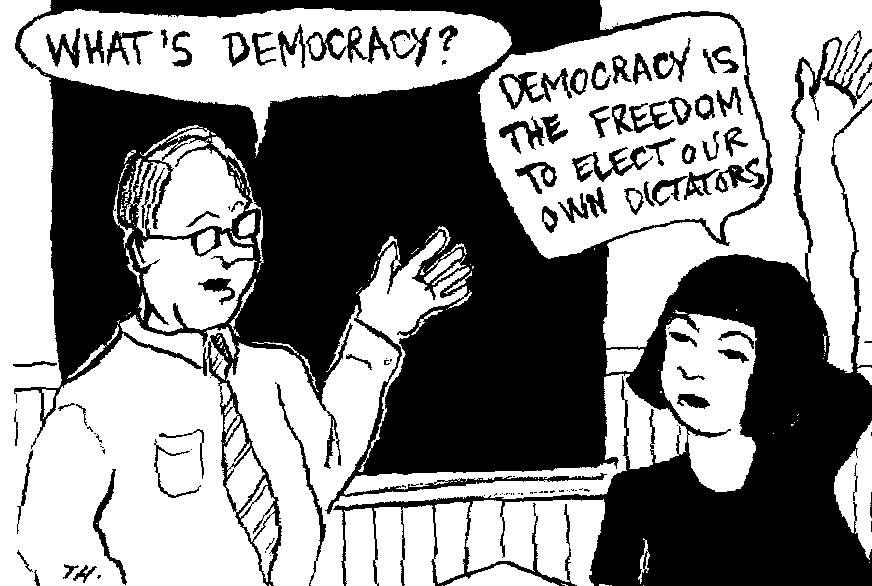
When ‘the coalition of the willing’ invaded Iraq, some of the most hard core politicians genuinely thought they could force Iraq into modern day democracy. Did they succeed? I think not... But! - what really *was* a success was the fact that a democracy was born from the ruins.

Not a democracy like we know it in the western world, but this is where we should remember that our democracies weren´t exactly free democracies in their childhood either. For instance, it wasn´t till the 20th century women were eligible for governing organs and neither did they have the right to vote in most western democracies before 1930 (in fact, the final canton in Switzerland to give women the right to vote didn´t till 1984!)

Iraq began its journey toward democracy following the invasion, but the Iraqi people have to find out the rest for themselves...

The same goes for children. You cannot force upon them the complete understanding you have gained from experience. They need to figure it out for themselves. But what you *can* do is force them to stop for a moment and think. And when they stop to think, they just might come to the conclusion that it is better to start listening to you.

Here there is something very, very important to understand about the use of force: you have to let go of that tool as soon as you see them stop and think. If you don´t, you shift the focus for learning from 'learning best way' to 'learning how to make mum and dad happy.' 

I probably don´t have to say this, but I´ll do anyway: This is just as useful in the discipline of raising kids as Burgers and fries as the main meal is good for your health.

The use of force is ONLY to be used as a wakeup call, nothing more. If you continue the use of force after they start to listen, you will force the child to replace their own thinking with an escape plan: ‘how can I get mum and dad to like me again?’ And this is never good.

Instead, as soon as you see the child stopping to think, let go of the power. Give the kid a chance to make up his/her mind and figure out that the best course of action right now is to listen.

Fear the right thing
My second point is about fear. Having a basic understanding that children are human beings with less experience and equally valuable to any adult, the intuitive understanding of fear is that if the kid experiences fear, it can never be a good thing... However, it´s a bit more complicated than that.

All human being experience fear and in modern society fear is one of the most common barriers for success. Fear can make us hide when we need to stand tall and fear makes us bend to other people´s will, when we need to make up our own minds. For those reasons (and many more) the popular understand is that fear is, per definition, ‘bad’ - but really that´s not the case. Fear is neither bad nor good. It´s how we react to our fears that determines good or bad.

My father-in-law was a farmer and the first time I entered the stable I had somewhat of a chock. The sight of 50+ milking cows´ rear end lined up on each side of me made me freeze right there on the spot. This was new to me and I was struck with fear, because I didn´t know how to handle these animals. Fear made me cautious; a good thing. My response to this fear was to observe, how my father-in-law handled the cows and little by little, I learned how to handle them as well.

I feared the cows and looked to my father-in-law to learn how to handle them and this is exactly what your children need to do in their lives: they need to understand that listening to you and observing how you do things can benefit them.

In other words: if your kids fear you, it´s a bad thing - but if your kids fear not listening to you, it´s a good thing!

Let´s sum up this post:

#1 - Force is a tool for change - As a parent, if you want your children to learn from you, power is to be used with caution. You cannot force your experience upon them and if you try, they won´t gain any wisdom. They will only become experts in making mum and dad happy. And even more importantly (though this is not very clear in the above due to my wish to economize writing space) if you try to force your experience on them, their focus will be on weither mum and dad loves me or not as opposed to mum and dad knowing best.

#2 - Fear the right thing - The use of power is a tool for getting the attention of your kids, but it´s important to let go of that tools as soon as you reach that goal - if you don´t, your kids will fear *you* instead of fearing their surroundings and look to you for help and wisdom. However, using force in the above mentioned way, you can get their attention and as they experience over and over again, what happens if they don´t listen to you, they will learn that one important lesson: listen to mum and dad, because they have been around for some time and most of the times, they have a few things to teach me.


For a tool using these principles, see this

Now, it´s your turn.  Do you have experience you want to share?